

A BMI calculator is one of the easiest ways to understand whether your weight is in a healthy range for your height. It is quick, widely used, and helpful for people who want a simple snapshot of their overall weight status.
Whether you are using a body mass index calculator kg and cm at home or checking your results online, BMI gives you a useful starting point. It compares your height and weight to estimate whether you are underweight, at a healthy weight, overweight, or obese.
That said, BMI is not the full story. It is a general indicator, not a diagnosis. This guide will help you understand how BMI works, how to calculate it, what the results mean, how it differs for children, where it has limitations, and what other measures can support a more complete picture of health.
What is BMI?
BMI stands for Body Mass Index. It is a numerical value calculated from a person’s weight and height. The purpose of BMI is to estimate whether body weight is appropriate for height.
Instead of looking at weight alone, BMI adds proportion. This matters because a taller person will naturally weigh more than someone shorter, and that extra weight may still be perfectly healthy.
A BMI online calculator in kg is commonly used because it simplifies the process. You only enter your weight and height, and the tool instantly gives your BMI score along with a weight category.
How to Calculate BMI
BMI can be calculated using either metric or imperial units.
For metric units, the formula is:
BMI = weight (kg) ÷ height² (m²)
For example, if a person weighs 75 kg and is 1.77 m tall, the BMI would be:
BMI = 75 ÷ (1.77 × 1.77) = 23.9
For imperial units, the formula is:
BMI = 703 × weight (lbs) ÷ height² (inches²)
Although the formula is simple, many people prefer a body mass index calculator in kg and cm because it is faster and more accurate than doing it manually.
BMI Categories for Adults
For adults aged 20 years and above, BMI values are generally interpreted using standard categories.
| BMI Range | Weight Category |
|---|---|
| Below 18.5 | Underweight |
| 18.5 – 24.9 | Normal weight |
| 25 – 29.9 | Overweight |
| 30 – 34.9 | Obese Class I |
| 35 – 39.9 | Obese Class II |
| 40 and above | Obese Class III |
These categories are used for both men and women, although body composition can still vary significantly from person to person.
Why People Use a BMI Calculator
A BMI calculator is popular because it is simple, accessible, and useful in many everyday situations.
People often use it to:
- track weight-related health status
- support diet and fitness goals
- Monitor lifestyle changes over time
- understand medical or insurance assessments
- Check whether weight may be increasing health risks
A BMI percentage calculator or BMI online calculator kg can be especially useful for those who want quick results without manual calculations.
Adult BMI Chart
The chart below helps show how BMI changes based on height and weight combinations. It gives a practical way to estimate BMI without calculating each value manually.
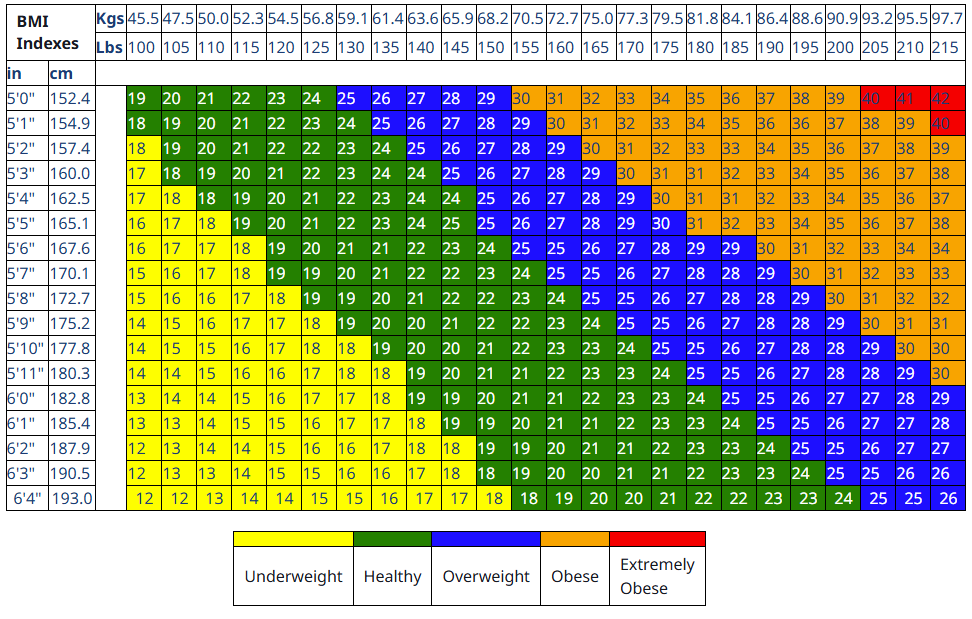
Weight bands in this chart broadly progress from underweight to healthy, overweight, obese, and extremely obese as BMI values rise.
BMI for Children and Teenagers
BMI is interpreted differently for children and adolescents because their bodies are still growing. A child’s BMI must be compared with age and gender, which is why a BMI and percentile calculator is used rather than adult BMI categories.
For children, BMI is assessed using percentile charts. These show how a child’s BMI compares with others of the same age and sex.
| Percentile Range | Weight Category |
|---|---|
| Below 5th percentile | Underweight |
| 5th to 85th percentile | Healthy weight |
| 85th to 95th percentile | At risk of overweight |
| Above 95th percentile | Overweight |
Health Risks of a High BMI
A BMI above the healthy range can increase the risk of several conditions. Excess body weight can affect the heart, metabolism, joints, sleep, and overall quality of life.
Some common risks linked to a high BMI include:
- type 2 diabetes
- high blood pressure
- coronary heart disease
- stroke
- sleep apnea
- osteoarthritis
- fatty liver disease
- gallbladder disease
- certain cancers
- depression and reduced quality of life
The higher the BMI, the greater the chance of long-term health complications.
Health Risks of a Low BMI
Being underweight also comes with health concerns. A very low BMI may indicate poor nutrition, low immunity, or an underlying medical condition.
Common risks include:
- malnutrition
- anaemia
- vitamin deficiencies
- osteoporosis
- hormonal imbalance
- fertility concerns
- fatigue and weakness
- lowered immunity
- growth and development issues in children
Low BMI should be taken seriously, especially if weight loss has happened without an obvious reason.
What Are the Steps to Maintain Optimum Health?
Good health is not built on one reading alone. A BMI calculator can help you track one aspect of your wellness, but real health depends on daily habits and consistency.
To maintain optimum health, it helps to focus on a few practical lifestyle habits.
Maintain a healthy weight. Reaching and sustaining a weight that suits your body can support heart health, mobility, and energy levels.
Stay physically active. Regular movement, such as walking, jogging, cycling, stretching, or strength training, can improve overall fitness and reduce the risk of lifestyle diseases.
Follow a balanced diet. Nutritious meals made with whole foods, fruits, vegetables, proteins, and healthy fats support long-term health far better than heavily processed food.
Track your health from time to time. Keeping an eye on your weight, sleep, activity, and overall health can help you notice unusual changes early. BMI can be one part of that routine.
Stay hydrated. Adequate water intake supports digestion, circulation, muscles, and temperature regulation. Even mild dehydration can affect how you feel and function.
Get quality sleep. Rest is essential for recovery, mood, concentration, and hormone balance. Poor sleep over time can affect both mental and physical health.
Practice good hygiene. Simple habits like washing hands, cleaning frequently used items, and maintaining personal hygiene reduce the risk of infections and illness.
Limitations of an Online BMI Calculator
BMI is useful, but it is not perfect. It gives a broad estimate rather than a complete picture of health.
One major limitation is that BMI does not distinguish between fat and muscle. A muscular person may have a high BMI even if they have low body fat. This is why athletes or people who do strength training can sometimes appear overweight by BMI standards.
BMI also does not show where fat is stored in the body. This matters because excess fat around the abdomen is often linked to greater health risks than fat stored in other areas.
There are also natural differences that BMI does not fully capture, such as sex, age, body composition, ethnicity, and stage of growth. Women generally have a higher natural body fat percentage than men, older adults may have more body fat at the same BMI, and children need age-specific interpretation.
For these reasons, BMI should be used as a guide rather than the only basis for judging health.
Alternatives to BMI for Assessing Health Risk
Because BMI has limits, it is often better used alongside other measurements.
Waist circumference is one of the most common alternatives. It estimates abdominal fat, which is closely linked to metabolic and cardiovascular risk.
Waist-to-hip ratio is another useful measure. It compares the waist and hip measurements to assess how fat is distributed around the body.
Skinfold thickness is also used in some settings. This method estimates body fat by measuring the thickness of fat under the skin at specific sites.
These methods do not replace BMI completely, but they can provide a more detailed picture.
What is the Ponderal Index?
Ponderal Index, or PI, is another way to estimate body leanness. It is similar to BMI, but instead of dividing weight by height squared, it divides weight by height cubed.
For adults, the formula is:
Ponderal Index = Weight (kg) ÷ Height³ (m³)
For infants, the formula is:
PI = (Birth weight in grams × 100) ÷ (Crown heel length in cm)³
Ponderal Index can sometimes be more useful for very tall or very short individuals because BMI may not always reflect their body proportions accurately.
Ponderal Index Categories for Adults
| Category | PI Range |
|---|---|
| Severe Underweight | Below 8 |
| Underweight | 8 – 11 |
| Normal | 11 – 15 |
| Overweight | 15 – 17 |
| Obese | 17 and above |
Does BMI Affect Your Health Insurance Premium?
Yes, BMI can influence health insurance premiums because insurers often use it as one of the markers of health risk.
A BMI above the healthy range may suggest a greater chance of obesity-related conditions such as diabetes, hypertension, or heart disease. Since these conditions can increase the likelihood of future claims, insurers may charge higher premiums to applicants with a higher BMI.
A very low BMI can also raise concerns. It may be linked to nutritional deficiencies, low immunity, or other health issues, which can also increase perceived risk and affect premium pricing.
On the other hand, individuals whose BMI falls within the healthy range are often viewed as lower-risk policyholders. In some cases, this can work in their favour when premiums are being assessed.
BMI is not the only factor insurers consider, but it often plays a meaningful role in the overall risk evaluation.
BMI is reliable as a screening tool for many adults, but it should not be treated as a diagnosis. It is most useful as a broad indicator that helps identify whether further attention may be needed.
For athletes, pregnant women, children, elderly people, and individuals with unusual body composition, BMI can be less accurate. In these cases, medical professionals often use BMI alongside waist measurements, medical history, blood markers, and other health assessments.
A BMI and percentile calculator is also more appropriate for children than adult BMI charts.
Conclusion
A body mass index calculator kg/cm is a practical and widely used tool for estimating whether your weight is in a healthy range for your height. It is quick, simple, and useful for building general health awareness.
Still, BMI is not a complete measure of wellness. It does not distinguish fat from muscle, account for body fat distribution, or explain every health risk. That is why it works best when used with other indicators and sensible health habits.
If you use a BMI online calculator kg, treat the result as a starting point rather than a final verdict. Real health is shaped by everyday choices, consistent habits, and a broader understanding of your body.
